PILOT SHORTAGE OR TOO MANY BROKEN DREAMS? THE STORIES I HEARD FROM MORE THAN 100 PILOTS
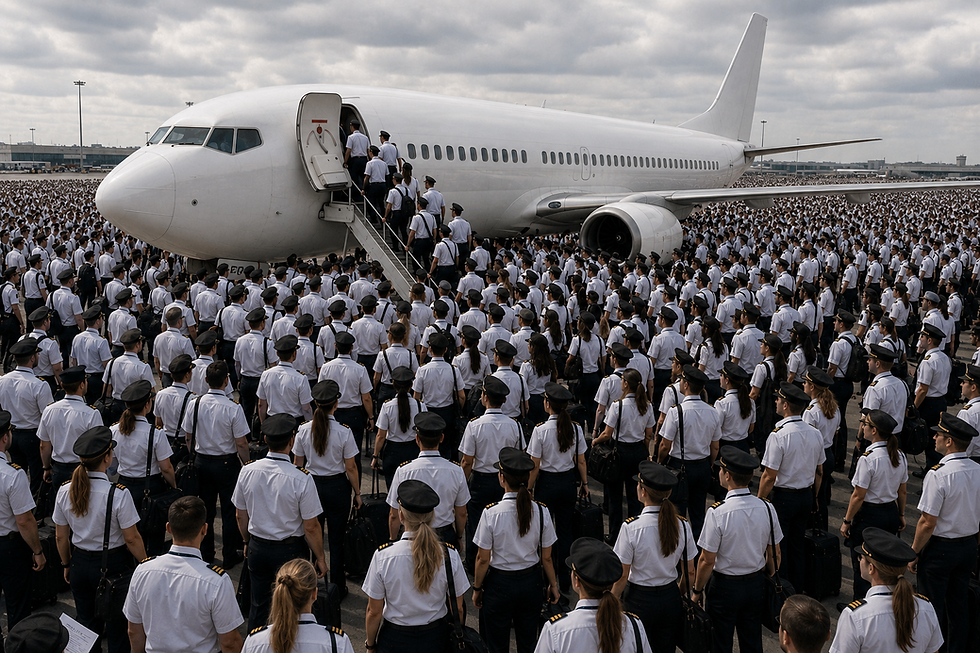
“I feel sorry for the young people I am teaching to fly,” a flight instructor at a school in Spain tells me. “I feel sorry because I know that the vast majority of them will never become commercial pilots. They are just as excited as I was when I entered this world many years ago.”
This is how my conversation with Armando begins (a fictional name to protect his identity). Armando has been trying to get a job at an airline for years, but so far, all he has managed to accumulate are debts and psychological problems.
Armando’s story is also the story of María, Luis, Ana, and hundreds of pilots currently in Spain. These are stories that nobody wants to tell because they don’t look good in any brochure or flight school marketing campaign.
People who have completely lost their voice because they cannot say anything on social media due to the enormous fear that exists in this industry. If you say something and someone sees it, you will be labelled as a difficult or troublesome person. So you have to keep quiet and carry on. Keep sending CVs to companies all over the world, hoping that one day, someone, somewhere, will call you.
Who I am and why I started investigating this issue
I am Eva Mars, a coach specialised in interviews for the aviation sector. For years, I have helped pilots, from cadets to captains, prepare for airline selection processes in Spain and internationally.
Over this time, I have seen that getting your first job has always been difficult, but in recent years the situation has worsened. I meet pilots who have been sending CVs for months or even years without receiving a single invitation to a selection process.
At first, you might think: “Well, maybe they are bad pilots, they perform badly in the simulator, or they have poor grades. In that case, it’s normal that nobody calls them.” But when you analyse the cases in detail, you see that many of them score more than 90% in their exams. We cannot know whether they are good or bad pilots because they are not given the opportunity to prove themselves: they are not even invited to the selection processes. Therefore, the problem is not that there are too many poorly trained cadets. Perhaps there are simply too many cadets for too few positions. The reality is that, today, very few airlines open their selection processes to pilots without experience.
At the same time, a large part of the marketing campaigns run by aviation schools continue to rely on the message that there is a pilot shortage and that employment opportunities are practically guaranteed. This contrast is what led me to investigate the issue.
My objective is to give a voice to those who are experiencing this reality and to provide perspectives that help us better understand the current labour market situation.
I also hope that this work will help those considering starting a career in aviation make a decision with a more complete picture of the reality.
Lack of official data
One of the most striking aspects of the debate surrounding the alleged pilot shortage is the lack of public data. In an effort to obtain this information, we contacted the Official College of Commercial Aviation Pilots (COPAC) and other organisations connected to the industry. COPAC informed us that it does not have this data.
The information available on the training of new pilots is also scarce and lacking in transparency.
In many European countries, there is no easily accessible public register showing how many professional licences are issued each year. Among the data that we have been able to locate are figures published by the German aviation authority. According to these figures, 1,095 ATPL exams were passed last year. In Spain, according to information published by Cadena SER, citing data from AESA, 984 pilot licences were issued during 2024.
If Germany and Spain alone are producing close to 2,000 new pilots every year, it is worth asking what the total figure might be across Europe. The five largest aviation training markets — the United Kingdom, France, Germany, Italy and Spain — are home to more than 700 Approved Training Organisations (ATOs), although not all of them offer ATPL programmes.
Based on the data available, everything suggests that Europe is adding several thousand new pilots to the labour market every year.
Two Very Different Realities Depending on the Flight School
One of the clearest differences can be seen between flight schools that have agreements with airlines and those that do not. Students at schools with these types of partnerships tend to enter the job market gradually. After completing their studies, many gain access, within one or two years, to recruitment processes organized by the school itself in collaboration with various airlines. Even so, the data I have collected is far removed from the 95–97% employment rates that some schools advertise on their websites.
The situation is very different for students at schools that lack these agreements. I have spoken to pilots who have spent three, four, and even five years sending out CVs without ever being invited to a recruitment process. Others, after several years of searching, have only managed to participate in a single interview.
At several of these schools, some former students have even gone so far as to describe the experience as a “scam.” They explain that, before enrolling, they were given the impression that there was a shortage of pilots and that job opportunities were plentiful. However, the reality they describe is very different. At one of these schools, none of the 20 students who completed the course had secured a job as a commercial pilot one year after obtaining their license and, according to the testimonies collected, almost none had even been invited to a recruitment process.
At another school, according to the testimonies collected, only around 10% of students had found work as commercial pilots three years after completing their training.
Some candidates have sent their CV to the same airline seven, eight, or even nine times without receiving a response. I have also spoken to a pilot who finished his training just eight months ago and has already submitted nearly 100 applications to airlines around the world without receiving a single response.
The Emotional Impact
The psychological consequences of this situation can be devastating for many pilots. Some say they need treatment for anxiety caused by employment uncertainty and the financial burden of having invested more than €100,000 in their training without any clear prospect of recovering that investment.
While waiting for an opportunity in aviation, many work in jobs unrelated to the profession they trained for, such as hospitality, retail, or ride-hailing platforms. There is, of course, nothing negative about these jobs, but they can be performed without having made an investment of that magnitude. At the same time, they watch as friends who chose other careers have already achieved financial and personal stability, while they continue submitting applications and dealing with their debts. In some of the cases I have come across, this prolonged situation of stress and uncertainty has even led to addiction.
When speaking to pilots who have just completed their training, I sense excitement and optimism. Most are convinced that they will start receiving calls within a matter of months. However, that perception changes radically when you speak to those who have spent one, two, or three years trying to secure their first job. Their state of mind is very different: disappointment, frustration, and, in many cases, a feeling of having been deceived are predominant.
As part of my research, I interviewed Tony S. Cano, a B737-rated captain at a European airline.
Is the Alleged Pilot Shortage Real?
Tony: This is a long-standing claim in the aviation industry. The problem is that it is generally made by manufacturers or organizations that are in some way connected to pilot training. If there were a genuine shortage of pilots, we would be seeing a number of clear effects in the market that are not currently evident. Airlines would have difficulty operating flights due to a lack of personnel, which would lead to constant announcements of recruitment campaigns. Furthermore, the terms and conditions offered to pilots would show substantial improvements, which is far from reality. In fact, we can even find the opposite: a deterioration in those conditions. A well-known low-cost airline in Northern Europe offers newly hired pilots a 40% reduction in their contract terms for five months. These conditions have been in place since the post-COVID period. If there were a genuine shortage of pilots, such conditions would not have been sustainable.
Boeing estimates that Europe could need an average of 6,000 pilots per year. However, it is important to bear in mind that Boeing's estimates are always based on an optimistic analysis that does not take into account the enormous number of variables that can alter those projections. In fact, one of Europe's strongest airlines had planned to make 800 hires in 2025. This year, it has cancelled more than 20,000 flights.
All these contextual factors that provide a realistic picture of the market—crises, wars, weak winter peaks, fuel prices, social changes, etc.—are not usually taken into account in forecasting studies, yet they have a significant impact on hiring.
Flight schools tend to focus on forecasts of future demand for pilots. This is understandable, since their business depends on new students deciding to invest in training that can cost more than €100,000. Positive employment prospects make it easier to attract students.
Aircraft manufacturers also regularly publish forecasts about future pilot requirements. These estimates are usually linked to projections for global fleet growth and air traffic. In addition, there is an economic ecosystem surrounding aviation training that involves manufacturers, training centers, and simulator providers. It is worth remembering that they also sell aircraft-specific training courses, sometimes in conjunction with each aircraft program.
Airlines tend to take a more cautious position regarding the existence of a pilot shortage. Acknowledging recruitment difficulties can increase pressure on salaries and working conditions during collective bargaining. Conversely, airlines often emphasize the availability of candidates in the market or their ability to train new pilots to meet future needs.
Pilots probably have one of the most balanced perspectives on the phenomenon, because they experience its consequences directly. They are aware that there may be difficulties in finding certain profiles—for example, experienced captains or pilots qualified on a particular aircraft type—without this necessarily implying a general shortage of pilots. For this reason, many aviation professionals distinguish between an absolute shortage of pilots and a shortage of pilots who meet specific requirements in terms of experience, type rating, or geographical availability.
Therefore, it is not that pilots will not be needed in the future. Rather, expectations about the growth of the profession need to be more realistic. The news reports about a pilot shortage, which can give the impression that the industry is heading toward a kind of staffing crisis, are quite far removed from reality.
What Signs Would a Market with a Genuine Shortage of Professionals Show?
Tony: A market genuinely suffering from a shortage of pilots would definitely tend to show a rapid improvement in the terms and conditions offered to new hires, while collective agreements would also be renegotiated with clearly improved conditions. Before the pandemic, a well-known low-cost airline even offered captains a €10,000 joining bonus. Another company in the Middle East operating scheduled and charter flights also offered retention bonuses worth several thousand euros. And when there are no substantial salary increases, improvements are usually made in other areas that pilots value highly, such as rosters.
We are not seeing any of this today. Not even airlines in regions that traditionally offer the best conditions, such as the Persian Gulf, have substantially improved their terms and conditions recently. What does occasionally happen is that certain regions experience temporary spikes in demand, as happened recently in the United States, where programs were opened for foreign pilots to obtain green cards so they could work there. However, this was a limited measure intended to alleviate a temporary situation.
How Have Working Conditions Evolved in Recent Years?
Tony: In general terms, they have deteriorated. Increases have been driven by temporary spikes, but anyone working in the industry knows that over the past 15 years there has been no significant improvement in working conditions. Only pilots at stable airlines with many years of seniority may feel that their salaries have kept pace reasonably well with increases in the cost of living.
Airlines, in particular, have found one variable that they exploit extremely effectively to avoid improving other conditions: the operating base. They have realized that, for many pilots, being based at home or close to home is a priority. Therefore, they are able to sacrifice other working conditions as long as they give pilots the base they want.
Imagine you are someone who lives in Seville and are qualified on the B737. Your only possibility of being a pilot while living at home is the only low-cost airline operating that type of aircraft there. Before the arrival of low-cost airlines, which established operating bases beyond the traditional hubs of Europe's major cities, there was greater awareness that being a pilot was a profession that involved being less tied to one place. It was taken for granted that you would have to leave home and perhaps never return. That perception has disappeared, and pilots are now looking for ways to stay at home rather than simply looking for a job.
What Difficulties Do Cadet Pilots Currently Face Compared with Previous Generations?
Tony: These are different times in aviation. In the past, the problem was gaining experience. It was more common for airlines to require even pilots without a type rating to have between 1,000 and 1,500 flight hours, meaning they had to find a way to gain that experience in general aviation.
Today, airlines generally look for two types of first officers, depending on the market: pilots with no experience, who may be recent graduates of a flight academy, or experienced pilots, where "experience" means already holding a type rating for a specific aircraft and having hours on that aircraft. That is the general trend. There may be occasional openings, such as one recently advertised by a Scandinavian airline looking for experienced but non-rated pilots. However, this is not the standard type of vacancy you usually see.
Therefore, for a cadet who has just completed training, I would say the main difficulty is financial. In addition to the training itself, they will have to pay for a type rating, with a certain degree of uncertainty attached to it. Ten years ago, paying for a type rating at least generally meant that you would find a job, although there were still type-rating-plus-hours programs that guaranteed nothing.
Today, more pilots obtain their license, fail to find a job, and then pay for a type rating in the hope that it will open doors and increase their chances of being called for an interview. But sometimes this may not be desirable, because airlines prefer candidates to pay for the type rating themselves. For many airlines, training is a source of revenue.
Another difficulty they face is that a significant part of aviation, at least in Europe, has become highly seasonal. There is a very high level of activity during the summer, but much less during the winter. As a result, when airlines have temporary staffing needs or offer temporary contracts, they tend to rely on pilots who are already type-rated and have some experience. Consequently, newly licensed pilots can only really wait for low-experience cadet recruitment campaigns during periods of growth or when an airline is undergoing a firm expansion and needs to recruit them, because highly experienced pilots generally already have jobs.
What Message Would You Give Someone Considering Starting This Career?
Tony: They need to carry out a thorough and objective analysis. Relying solely on the information provided by a flight school is essentially cheating yourself. Nowadays, there are many ways to do your own research. One effect of social media is that it has made it easy to reach almost anyone. Therefore, it is easy to contact pilots or people who do not have a particular interest or vested interest, such as a flight school, and get information from them.
A Few Final Words
Eva: I would like to thank everyone who made this article possible by sharing their stories and experiences so openly and honestly.
As a final reflection, I would like to add that although this article has compiled some of the most difficult experiences, there are also many positive stories of pilots who obtain their licenses and find work within a short period of time.
The purpose of this article is not to discourage you if you are considering becoming a pilot, but rather to offer you a complete picture of the reality. My intention is for you to be able to make an informed decision, knowing not only the marketing messages of flight schools, but also the real experiences of those who have already walked that path.
SOURCES:

Comments